
Items
-
FOOD SECURITY AND VULNERABILITY IN SELECTED TOWNSAuthor: WFPDate: 2009Executive SummaryThe impact of inflation that started increasing in 2005 resulted in increased food insecurity inurban areas of Ethiopia. The prices of cereals increased by more than 100% since mid 2005 whenthe country faced a spiral of price increases. The ‘new emergency’ facing the urban poor as aresult of the rapid food price increase led the Government to initiate an urban grain marketstabilization program in 2007. The program started initially in Addis Ababa and was expanded to cover 12 towns. From April 2007 the Government sold over 420,000 MT of wheat to urban consumers at a subsidized price. The Government continued with the program in 2008 and 2009 with further grain imports for the program.
-
Harar Hyenas Apre A 'shuraAuthor: Marcus BaynesDate: 2009Apre A'shuraThere are quite a few versions of the history and the events of the hyena feeding of Ashura, so I’ll condense them into one, generic version. Essentially the story goes that there was a famine in Harar and that due to the shortage of food, the hyenas had taken to attacking and eating the people. It became such a problem that the people protested and demanded that something be done to stop the attacks. The town’s saints held a meeting on Mt Hakim and decided that the hyenas should be fed porridge and in return the hyenas should not attack anyone. This was successful and as a result, the truce is celebrated each year at A’shura, when the hyenas are fed porridge with lashings of butter at various shrines in the land around Harar. The other versions have a similar theme to the above: Widespread famine, people being attacked, solution sought, solution found by feeding hyenas porridge.The actual feeding has a mythological ring to it. People say that after the porridge is laid out for the hyenas, the hyena king comes first to test it. They say that the hyena king is very handsome, very graceful and completely white. Although I have heard from some people that he can be completely black, but either sounds a little incongruous for a hyena. The hyena king tests the porridge by looking for his reflection, and if he can see it, he tries some. If he approves of the porridge he signals to the other hyenas to come and eat the porridge at which point the others come and join in. It’s best if they eat most but not all, as that means it will be a good year with no drought, famine or pestilence, but it’s up to the murid of the shrine to determine exactly the meaning of the leftovers.As I said, many have tried to film this hyena porridge-eating and all have failed. So we set off from Harar for Aw Nagus (the shrine of Saint Nagus) on Saturday afternoon, full of anticipation but highly sceptical and not expecting to see any hyenas eating porridge. I mean, honestly, hyenas eating porridge? Be serious. But we knew for certain there would be all-night celebrations including dancing drumming and singing zikris, which alone would be worth driving 50kms on unmade roads to see. We arrived around dusk and were shown the compound beside the shrine. There was a room for the men’s business and a room for the women and children (which also contained sheep), a kind of chill-out room and a room for the healing rituals. I went around back to see the women preparing the porridge. It was bubbling away in a big cauldron, with two women stirring it using metre long wooden poles, and a bunch of other women singing and laughing all the while. In the men’s room each of the men had been given a chapter of the Quran to read and they did this until all chapters had been completed. After that, they made supplications and prayed and apparently this was to continue until the hyenas came. In the women and childrens’ room there was drumming and singing and things were a little less earnest.After a couple of hours, the porridge for the hyenas was carried out in bowls on the top of some young womens’ heads. And if you’ve ever seen an Oromo woman carrying something on her head, you’ll understand how incredibly graceful this procession was. The women took the porridge to a stone slab, set in the ground beside the wall of the shrine and laid out three perfectly circular mounds of porridge, each about 30cm diameter and with a depression in the middle so that they looked like three big white doughnuts. Then some older women took some ghee and poured it in the middle of the porridge so that each had a little pool of butter. After they did this, I went up to the wall beside the shrine and found myself a position which I hoped would be comfortable, as I was expecting to be sitting there for some hours waiting for the hyenas to come, if at all. The organisers had anticipated the potential problems, so there were soldiers at hand who herded the local children together and made them stand in a huddle near the water tank. To the untrained eye it looked for all the world as though the children were about to be executed. Meanwhile, all the adults except myself, a news cameraman, a journalist and a few VIPs had retired to the respective rooms around the compound to sing and pray and entreat the hyenas to come.About 5 minutes after the porridge had been set down and just as I’d settled in my position at an oblique angle to the slab and about three metres above it, a hyena came out of the bushes and started lapping up the ghee. I was both incredulous and panicked as I hadn’t even switched on my camera, so I sat there fumbling with the buttons, praying that the hyena wouldn’t run off before the camera started up. Luckily the hyena stayed and I filmed most of the action. It lapped up the ghee in each mound and tasted some of the porridge, before moving on to the next. I was looking in my viewfinder, incredulous, that this lone hyena (hereafter referred to as the hyena king) was doing almost exactly what the legend had said. I was also gesticulating madly at the other people who had positioned themselves directly in front of the porridge and who the hyena king kept looking up at, being very skittish. He looked like a hyena about to run away and I was hissing at the journalist to switch off the torch that he was shining on the hyena (they’d been told not to use any lights, I was using infrared) and an insufferable VIP who kept taking photos with a flash. They ignored me so instead I gesticulated to the soldier behind me to shoot them, but he ignored me too. So the hyena king, after having just tested the third mound of porridge, took fright from the lights and disappeared into the bushes. And so began the long wait for the other hyenas to come and eat. We waited for an hour, while more and more people gathered at the wall, and we could see the hyenas about 30 metres from the shrine but refusing to come and eat. They’d found a cow’s rear end that must have been put there to attract them and were far more interested in that, than in three mounds of gheeless porridge. That was when a dog arrived and decided it wanted to be part of the tradition of A’shura and began eating the porridge. A soldier dispatched the dog with a well-aimed stone and it ran off to go and harass the hyenas. Then two men decided to drag the cow’s rear end over to where the porridge was, presumably in the hope that the hyenas would give up the cow in favour of some white, lumpy, buttery stuff. I tasted some porridge myself afterwards and I must say, the cow’s rear end is a more attractive proposition. So after the hyenas had dragged what was left of the cow into the bushes, the murid decided that enough was enough and that the porridge should be ‘read’. He came out and made an examination and then an ox and a sheep were brought out to be slaughtered. This was done under the watchful gaze of the hyenas, just out torch-range, and in front of the dogs who had taken up the task of defending the meat from the hyenas. Most of the meat was taken to the compound to be cooked for the celebrations, while the heads, skins and entrails were put out for the hyenas or the dogs; whoever wanted them the most.Any hopes of seeing the hyenas gathering to finish off the porridge were abandoned and the people returned to their respective rooms to sing zikris and perform healing rituals and so forth. The mens’ room was full, with about 80 men and boys and there was much chat chewing, singing, dancing and drumming. The drums were big and booming and the sound pushed against one’s chest when they hit them in centre for a bass beat. And the singing was repetitive, but infectious and seemed to me like of a kind of religious football song where there are certain zikris in which you insert the name of the relevant saint. And the murid announced his interpretation of the partly eaten porridge, promising a prosperous year with perhaps one calamity and success for those who had made the trip from Harar. All in all, the atmosphere was amazing and the hyenas were all but forgotten in peoples’ minds. There was one Australian researcher, however, who every now and then went out to check and see if the hyenas had come to eat the porridge. On my second visit to the wall, I could hear them squabbling in the darkness where the porridge was so I switched on my camera in the hope of getting some footage. But these guys were far more skittish than the hyena king and they scarpered each time they heard me near the wall, so as a result I can only claim to have heard, and not seen, them finishing off the porridge. But when I went to look at the stone slab at the side of the shrine below the wall, the porridge was indeed gone.I am no longer the sceptic I was. The hyena king was not all white, but was also not spotted apart from having a few spots on his knees. Personally, I think hyenas are beautiful, but I’d guess that most people would have concurred that the hyena king was not particularly handsome or graceful either. Yet he did test each of the mounds of porridge, just as the legend says, and he was followed, albeit much later, by the other hyenas who finished the stuff. For me it was the most amazing thing I’ve ever seen and I felt like I was at the interface between reality and mythology. The ceremony happens only once a year, yet the hyena king was ready and waiting for the people to leave so that he could test the porridge. In terms of hyena ecology, it’s a testament to the power of the hyena’s memory; in terms of the beliefs of the people, it’s a testament to the power of prayer; in terms of human-animal relationships it’s an affirmation of a relationship with wild animals based on recognition of the need for co-existence with minimal conflict and I feel so lucky to have been witness to it.The video of the hyena king is now in high demand. The news crew was unsuccessful using torch light (though they were successful in scaring the hyena away) so really the only video available is the infrared footage that I shot. I can’t hand over the tape to anyone though, because it also has footage of people dancing and singing and making porridge and my ethics approval doesn’t allow me share it. As far as the footage of the hyena king, I’ve been advised to sit on it until it can be decided what to do with it. So sorry about that, and I hope the above description will be enough for now.Source: http://hararhyenas.blogspot.com/2009/12/apre-ashura.html</
-
-
-
-
Women's Craft Guilds and Traditional Basketry of HararAuthor: Belle AsanteDate:Traditional Harari basketry within the Harari ethnic group. However, between the mid-1970s and the mid-1990s, a sharp decline in weaving among the younger generation of women became apparent to outside researchers, NGOs and the Harari alike. Moreover, the production of several seems to have been significantly reduced in those waning years of craft production.By the late 1990s, there was an attempt to preserve the material culture of the Harari people,and also provide a forum for groups of Harari women to gain greater economic self-reliance through craft work. The three women's weavers associations that were established within the old walled city of Harar at that time are still functioning. These fairly recently formed Harari women's craft guilds have yet to be effectively documented, yet their contributions to the preservation of the Harari way of life may be profound.After an introduction this paper will highlight some organizational differences, challenges, and successes of the three Harari women weaver’s guilds.
-
“Baskets of the World ” the Social Significance of Plaited CraftsAuthor: Dario Novellino - Fusun ErtugDate: 2005Baskets and woven mats are the oldest and most diverse plant-based crafts found around the world. The skill required in the production of these objects is often associated with factors such as people's perceptions of the environment, conceptions of the self and modes of economic interaction, social hierarchy, and division of labour. Basketry knowledge has also significant ecological ramifications,as it includes specific strategies for the sustainable management of plant resources. Moreover,the study of plaited crafts can be linked together with important themes such as the studies of plant distribution, the trade routes of human groups and the discovery, diffusion and transmission of new technologies and techniques.
-
Zikri rituals in HararAuthor: Simone TarsitaniDate: 2009These web pages were prepared by Dr Simone Tarsitani during a Leverhulme Trust Visiting Fellowship (November 2008 & September 2009) at the Music Department of the Open University, drawing on over ten years of research on the Islamic rituals performed in Harar, Ethiopia. The main purpose of the work has been to develop a comprehensive analysis of the performance of the rituals, based on the large body of audiovisual documentation collected during previous fieldwork. Zikri is the Harari word for the Arabic “dhikr” and refers to an exercise (typical of Sufism), which consists of the repetition of the name of God in order to receive his blessing. The rituals performed in the city of Harar, important centre of Islamic learning in Ethiopia, are derived from the influence of Sufi orders, widespread in the Islamized areas of the Horn of Africa. However, the cult of saints in Harar developed particular beliefs and rules that go beyond the discipline of Sufi orders and zikri rituals can be considered an original expression and one of the unique elements of the culture of this town. The wide repertoire of texts written in the local language, the sung melodies and their rhythmic accompaniment, the ritual and social function of their performance developed distinctive characteristics. Historically and contemporaneously, zikri rituals have permeated Harari life and the repertoire of songs has expanded beyond its origin of liturgical hymns, to become one of the facets of Harari identity.
-
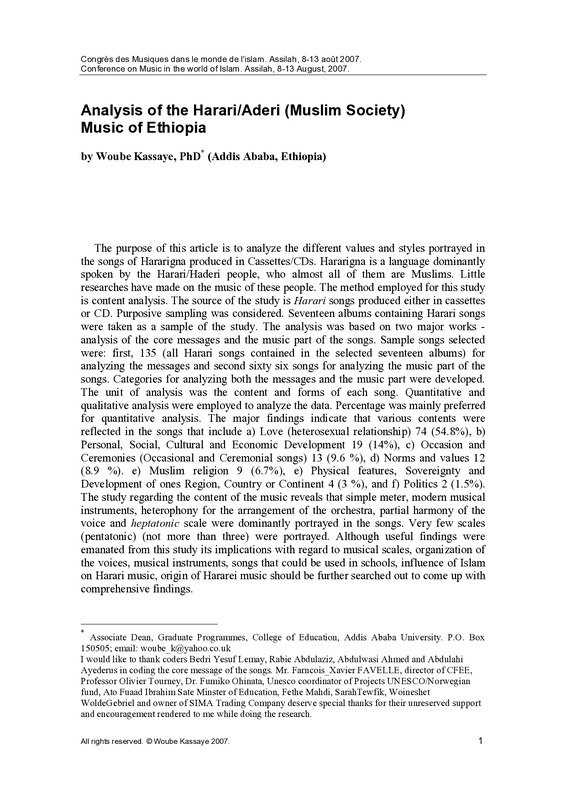
The Significance Of Harari MusicAuthor:Date: 2010College of Education, Addis Ababa UniversityABSTRACTThe purpose of this article is to show that cassette and CD recordings of Harari pop songs are significant and useful in promoting public policies in the education and culture sectors. The method employed for this study is both quantitative and qualitative analysis. The study is based on Harari songs released on seventeen cassettes or CDs, and is supplemented by an investigation of objectives set forth in Ethiopia’s Culture Policy, and Education and Training Policy. Purposive sampling was considered and categories were delineated for the songs as well as the objectives of the policies. Then the core messages of the songs were compared with the objectives of the policies. The education and Training Policy while eleven songs reflected the Cultural Policy. The core message of these and similar songs may best be evaluated in terms of the overt and subtle contributions of musical expressions in preserving local knowledge; they can be useful in promoting education, protecting cultural heritage, and maintaining societal norms and values.
-
Texts in Mawlid Collection of HararAuthor: Alessandro GoriDate: 2010In my paper I would like to try to describe in a philological and comparative perspective the content of the constellation of texts most commonly known under the title of number of manuscripts kept in Harar, in Ethiopia and abroad and in at least four different printed editions. It contains the basic textual material recited and sung in Harar during Mawlid sharaf al-‘alamin.” The collection is preserved and transmitted in a quite relevantMawlūd feasts and other collection will be dealt with. The complex and variegated nature of the in different suggestions that were at work in the process of formation and development of the tradition and the musical and liturgical functions of the texts of the collection will be analyzed.
-
-
Determinants of cigarette smoking among school adolescents in eastern Ethiopia: a cross-sectional studyAuthor: Ayalu A Reda1*, Asmamaw Moges1, Berhanu Yazew2 ...Date: 2010Health To assess the prevalence of cigarette use and its determinant factors among high school students in eastern Ethiopia. A cross-sectional study was conducted using structured self-administered questionnaires among 1,721 school adolescents in Harar town, eastern Ethiopia. Univariate and multivariate logistic regression analyses were performed to examine associations.
-
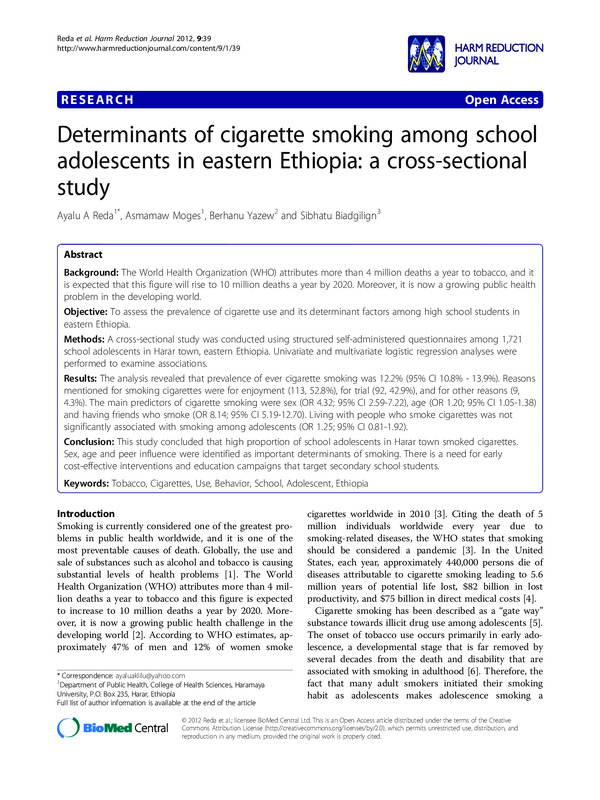 Determinants of cigarette smoking among school adolescents in eastern Ethiopia: a cross-sectional studyAuthor: Ayalu A Reda1*, Asmamaw Moges1, Berhanu Yazew2 ...Date: 2010HealthTo assess the prevalence of cigarette use and its determinant factors among high school students ineastern Ethiopia.A cross-sectional study was conducted using structured self-administered questionnaires among 1,721 school adolescents in Harar town, eastern Ethiopia. Univariate and multivariate logistic regression analyses were performed to examine associations.
 -
Harar Manuscripts: African Study Monograph 5-18 20102010Author: Simone Taristani, Belle Asante TaristaniDate: 2010INTEGRATING LOCAL KNOWLEDGE IN ETHIOPIANARCHIVES:MUSIC AND MANUSCRIPTS IN THE COLLECTIONOF ABDULAHI ALI SHERIFBelle Asante TARSITANIGraduate School of Asian and African Area Studies, Kyoto UniversitySimone TARSITANIDepartment of Music, The Open University, UKABSTRACTSince the early 1990s, important examples of Harari tangible and oral cultural heritage were preserved in the private home museum of Abdulahi Ali Sherif in Harar, Ethiopia.The volume and quality of audio recordings of musical and ritual practices, along with the manuscripts from this collection indicate how a resourceful individual, when supported by a community of local patrons, can be instrumental in conserving heritage in a local archive, even in the absence of major funding sources. This case study presents a review of Mr. Sherif’s museum collection and explores pertinent challenges in conservation and curatorship of the private holdings. Having followed the transformation of the collection to a public-private partnership,the authors consider the wider implications of collaborations in the management of archives in regional museums in Ethiopia. This research employs examples of various forms of documentation used in the analysis of local Islamic ritual practices to show that local actors are integral to the sustainable management of archives. The collaborations involving the collectionof music and manuscripts in the Sherif collection are presented as exemplary of how a community-run museum project can be a particularly appropriate and accessible venue to engage audiences in the legacies found in archives
-
Harar-Wallo Relations RevisitedAuthor: Hussein AhmedDate: 2010Department of History and Heritage Management, Addis Ababa UniversityABSTRACTSince at least the sixteenth century, the areas of the present day regions of Harar and Wallo have been important centres of teaching and diffusion of Islam as well as of preservation of Islamic culture and education. Preachers and scholars from these areas played a decisive role in the introduction and dissemination of the faith in the country, especially in the eighteenth and nineteenth centuries. They contributed to the further development and consolidation of both Islamic institutions and law, and mysticism as manifested in the propagation of the religious orders, veneration of saints, and visits to shines. They also actively promoted and sustained a tradition of Islamic reform and renewal. Overcoming their geographical distance,the two regions maintained close contacts through the Islamic school system, movement of teachers, students and instructional materials, and exchange of goods and services.
-
Cultural Identity, Islamic revivalism and WomenAuthor: Ilaria SaltoriDate: 2007Auhor discusses Harar Traditional Song and the Harai Women's Contribution
-
Assessment Report Of Harari People National Regional StateAuthor: MOFEDDate:SECTION 1: BACKGROUND AND PURPOSE1.1 INTRODUCTIONThe DSA Project is providing technical assistance to the Government of Ethiopia's Civil Service Reform in the areas of budget, accounts andexpenditure planning. The DSA Project is implemented by Harvard University and funded by USAID, Ireland Aid and the Netherlands Ministry for Development Corporation. The Budget Reform has so far been implemented with the support of theDSA Project at the Federal Government and in the Tigray, SNNP, Oromia,Amhara and Beneshangul/Gumuz regions. The Account Reform has sofar been implemented with the support of the DSA Project at the Federal Government and in the Tigray, SNNP and Amhara regions.The DSA Project was extended from July 1 2004 to November 30,2006 to ensure that the above reforms are extended to all regions and administrative areas of Ethiopia. A part of the work plan agreed with the Ministry of Finance and Economic Development envisages that the budget and the accounts reforms are introduced in Hararri Region in FY 1998-99.
-
-
BasketsAuthor: Michigan State University MuseumDate:Author: Michigan State University Museum Baskets (Finjaan Gaar) Name of Maker: Amina Ismail Sherif Ethnic Affiliation: Harari Date of Production: ca. 1993 Locale: unknown Country: Ethiopia Dimensions: h. 11.5 inches Media: plant fiber, pigments Collector(s) / Donor(s): Raymond Silverman & Neal Sobania MSUM Accession #: 7557.274.1 & 7557.274.2 The Collector(s) / Donor(s) Raymond Silverman, curator of “African Connections,” is an associate professor of art history at Michigan State University. He also serves as adjunct curator for the African collections housed in the University’s two museums. From 1979 to 1989 his research was focused in the West African countries of Ghana and Côte d’Ivoire, and from 1990 to the present, in Ethiopia. This object is one of several hundred artifacts that Silverman and Sobania commissioned and collected in the course of conducting research for the 1994 Michigan State University Museum exhibition, Ethiopia: Traditions of Creativity. Collector(s) / Donor(s) Statement: Silverman Neal Sobania is Professor of History and Director of International Education at Hope College in Holland, Michigan. After spending three years as a Peace Corps Volunteer in Ethiopia, he returned to graduate school, completing a Ph.D. at the University of London dealing with the history of the Dassanetch peoples of northern Kenya. Since his Peace Corps experience in Ethiopia in the late 1960s, he has been a avid collector of African material culture and possesses a significant collection of Ethiopian and Kenyan artifacts. For the last eight years, he and Silverman have been collaborating on a number of projects dealing with the visual cultures of Ethiopia. Collector(s) / Donor(s) Statement: Sobania The Object(s) Harar is an ancient walled city in eastern Ethiopia. Formerly, all Harari girls, as part of growing up, learned to weave baskets. In fact, before marrying, a young woman is expected to produce a set of specific types of baskets that she brings to her marriage as a form of dowry. In addition to their aesthetic appeal, these baskets function as utilitarian objects serving as covers for wooden and pottery containers, and as containers themselves. They also play an important role as markers of a woman’s social status. Upon entering a Harari house, one encounters a public sitting area whose walls are covered with baskets and other containers owned by the woman-of-house. Specific types of baskets represent different events in the a woman’s life and these are positioned in specific locations on the walls. Thus, one can “read” the arrangement of baskets and learn a good deal about a woman–whether or not she is married, whether she is widowed, how many of her sons are married, as well as the the relative prosperity of the household. Formerly, all women might have spent a few hours a day weaving baskets as part of their daily routine. But today, most Harari girls pursue a primary and secondary school education, which does not leave them enough time to learn to weave these baskets. Since the demand for marriage baskets still exists, a number of women, like Amina Ismail Sherif, have become professional, full-time basketmakers. This pair of baskets were produced for Michigan State University Museum by Amina in 1993. They are a type of basket known as finjaan gaar, a small lidded container used for holding candy, gum, or incense. Further Information Books and Articles Elisabeth-Dorothea Hecht. “Basketwork of Harar.” African Study Monographs [Kyoto], Supplement (18), 1992. Elisabeth-Dorothea Hecht. “The City of Harar and the Traditional Harar House.” Journal of Ethiopian Studies 15 1982: 57-78. Sidney R. Waldron. “Harari.” Muslim Peoples: A World Ethnographic Survey, edited by Richard V. Weekes, 313-19. Westport: Greenwood Press, 1984. Sidney R. Waldron. “Harar: The Muslim City in Ethiopia.” Proceedings of the Fifth International Conference of Ethiopian Studies, Session B, edited by Robert L. Hess, 239-57. Chicago: Office of Publications Services, University of Illinois, Chicago Circle Campus, 1979. Richard Wilding. “Harari Domestic Architecture.” Art and Archaeology Research Papers 9 1976: 31-37. Ahmed Zekeria. “A Harari Art: Basketry Through the Eyes of Amina Ismael Sherif.” Ethiopia: Traditions of Creativity, edited by R. Silverman, pp. 46-63, 258. Seattle: University of Washington Press, 1999. Internet Resources Artist Profile for Adamu Tesfaw from Ethiopia: Traditions of Creativity Richard Wilding. “Harari Domestic Architecture.” Art and Archaeology Research Papers 9 1976: 31-37.
-
Some body else: Arthur Rimbud in AfricaAuthor: Charles NicolleDate: 1880-1891Literary Criticism. 1999, 335 pages. The man being shaved is a Harari tailor called Hussein, a gentle, grizzled man. This village, above Harar on the Egon plateau, was the final stage.
-
Coffee: A Dark HistoryAuthor: Anthony WildDate: 2005323 pages. He crops up in three of the obscure outposts that feature in the story: St Helena, Batavia, and Harar, the cradle of coffee itself.
-
Chambers's JournalAuthor: Chambers LimitedDate:The party, which consisted of three British officers and fifty Indian troopers, arrived safely in Harar and saw the last batch of Egyptian soldiers.
-
NatureAuthor: Norman LockyerDate: 1885At Harrar, the largest town of East Africa, they were amicably received by the Egyptian governor, Abdallah.
-
Encyclopedia BritanicaAuthor: William Harrison De PyDate:Encyclopaedia Britannica: a dictionary of arts, sciences, and ...: Volume 11 - Page 454 William Harrison De Puy - 1891 - Full view Harar has long been the seat of a considerable commerce, though before the Egyptian conquests the merchants had to ... The rainy season at Harar begins about the 15th of March, and lasts for six months, the heaviest rains occurring ... books.google.com - Book overview
-
The Cambridge history of Africa: from c.1600 to c.1790, Volume 4 editedAuthor: Richard GrayDate:History of Harar and Other Moslem Kingdoms in Ethiopia