-
A total of 50 rhizobial isolates of field pea (pisum sativum) were collected from central Shewa, Gojam, Gondar, Wollo, Tigray, Arisi, Bale, Harar and Walayta. The rhizobia were isolated in culture and characterized using cultural, colony morphology and physiological characteristics. All isolates except three, changed bromothymole blue indicator to yellow indicating they are acid producers and fast growing and 84% of the isolates were fast growing and 16% were slow growing. The isolates showed diverse characteristics in their carbohydrate utilization, intrinsic antibiotic and heavy metal resistance. Most isolates from Harar and Arisi-Bale were found to be more tolerant to higher NaC1 concentration, pH (4.5 and greater than or equal to 9) and temperature (5 and greater than or equal to 38 C deg) extremes than others. Dendrogram obtained through cluster analysis using NT-STS version 2.1 in 62 phenotypic characteristics showed that isolates can be grouped into different clusters and groups. The relative symbiotic effectiveness of the isolates was determined in sand culture and analysis of plant dry matter, nodule number and total nitrogen uptake data using SPSS 11.5 at p=0.05 showed a significant difference among isolates. The highest dry matter of 3.35 g/plt was accumulated by each of the inoculant isolates of NSRIFP1 (Shewa) and NSR1FP5 (Gojjam) that were significantly different from the N-fertilized control, followed by NSR1FP2 and NSR1FP4 (Gojjam) that accumulated 2.91 g/plt and 2.60 g/plt, respectively. The percentage of total nitrogen (TN) per plants were ranging from 1.19 for isolate NSR1FP28 (Arisi-Bale), being the lowest, to 2.93 for each of isolates NSR1FP1 (Shewa) and 2 (Gojjam), being the highest. Most isolates from Tigray (86%), Shewa (80%), Gojjam (71%) and 67% of Gondar-Wollo were effective and very effective whereas, higher percentage of lowly effective and ineffective isolates were found from Harar and Arisi-Bale. The most effective isolates were NSR1FP 1 (Shewa) and 5 (Gojjam) with 133% dry matter accumulation relative to N- fertilized control and total nitrogen percentage (TN) of 2.93 and 2.88. The least effective isolate was NSR1FP47 (Harar) with 23% dry matter accumulation and 1.55 TN. In general, isolates were very diverse in many of laboratory and greenhouse tests. Hence, for better understanding of isolates to their interaction with host plant, further physiological, molecular and field studies are recommended.
-
Cash CropsCoffee and chat are Ethiopia’s major cash crops, with coffee cultivation in direct competition with chat, the second major agricultural export. Chat is a mild stimulant harvested from a shrub (Catha edulis), the fresh leaves of which are chewed, and popular in the arid regions of Ethiopia, Kenya, Djibouti, and Somalia. Domestically, chat is a major source of revenue in the southeastern areas of Ethiopia, with the bulk of the crop being ferried daily by air and truck to Djibouti and Somaliland via Harar and Dire Dawa. For farmers it offers far quicker returns on investment than coffee, although much of the sale price accrues to the merchants and distributors.
-
Stone, Dimension.—Basalt and scoria were used in road
construction. National Mining Corp. (NMC) (a subsidiary of
Midroc Ethiopia) mined and polished calcitic marble from the
Dalleti area in western Ethiopia. Saba Stones produced calcitic
marble in Tigre. Ethiopian Marble Industry (EMI) mined
marble at Harar in eastern Ethiopia and at various sites in the
western part of the country. EMI processed its raw materials in
Addis Ababa. Deposits of pumice occurred at the Gari Baldi
Pass and at Kimbibit in the Rift Valley; pumice was used in
domestic cement production. NMC produced amphibolite,
granite, and limestone. Ethiopia had a total of at least 34
deposits of dimension stone, with 10 operating quarries, and 4
processing plants (Mengistu and Fentaw, 2000; Mining Journal,
2002).
-
An historical and archaeological interpretation of the Extended East Route for cultural tourism, stretching across East Ethiopia, Somaliland and Djibouti.This brief study is composed of an introduction and a proposal to carry out a wide research in Ethiopian and North Somali medieval history, through a set of archaeological campaigns to understand better a minimally known period of great value. The proposal is centred on relationships to a new touristic route, applying action research methods. So that every finding means a new resource along the route and can become a revenue opportunity. Prof. Ahimed Zacariah, the noted Harari scholar, has been involved in excavations in the Harla sites between Harar and Dire Dawa. A team has recovered there in 1987 a coin supposed to be Chinese, and older than that recently unearthed in Mambrui, Kenya. It is the best proof so far of how far fledged the trades were. His job should be reinforced, to also better understand the Harla’s role in the trade chains.Koremi, a significant medieval site near Harar has never been appropriately dated. The Kundudo massif and its underlying valleys still hide Hubat, the fief and supposed birthplace of Mohamed al Ibrahimi, the conqueror of Abyssinia, and more towns. Seven in all affirms Cherif, the museum curator in Harar. One name I recall, Samti Guey. There should be six more. Beyond Babile, in one of the valleys of the present day Elephant Sanctuary was Bia Woraba, atown found and described by Phillips Paulitschke in the late nineteen hundreds as characterised by tall orderly stone walls. Meftuh Shash from Gursum and Toronto has only weeks ago seen there, also from Google earth imagery structures definitely worth a survey and consequent excavations.
-
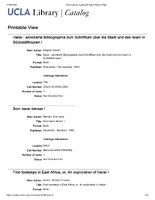
[ 1 ] Dimensions of locality : Muslim saints, their place and space / Georg Stauth, Samuli Schielke (eds.) 2008 Location: YRL Call Number: BP189.43 .D56 2008 Status: In Process - 9 ] Azaïs, François, 1870- Cinq années de recherches archéologiques en Éthiopie; province du Harar et Éthiopie méridionale, par R. P. Azaïs et R. Chambard. Préf. par Edmond Pottier. 1931 [ 40 ] Waldron, Sidney R. Social organization and social control in the walled city of Harar, Ethiopia / Sidney Ralph Waldron. 1976
-

-Harar. [electronic resource] Forschungsreise nach den Somâl und Gallaländern, Ost-Afrikas, ausgeführt von dr. Kammel von Hardegger und prof. dr. Paulitschke. Nebst beiträgen von dr. Günther ritter von Beck, L. Ganglbauer und dr. Heinrich Wichman Paulitschke, Philipp, 1854-1899. Leipzig, F.A. Brockhaus, 1888. Call Number: EBOOKS Available online -Harar : a cultural guide / text, David Vô Vân, Mohammed Jami Guleid ; in collaboration with, Berhanu Abebe. Vô Vân, David. Addis Ababa : Shama Books, c2007. Call Number: DT390.H3 V68 2007 Location: Butler Stacks (Enter at the Butler Circulation Desk) Harar y la rodilla rota : notas de lectura / Rafael Castillo Zapata. Castillo Zapata, Rafael, 1958- [Venezuela] : bid&co.editor, 2006. Call Number: 7JUN 1552
-
Italian to English translation from Googlekhadija Paola PastacaldiPequod publisher, 250 pagesThe historical image of the novelThe story of "Khadija" was built on the historical sources of the late nineteenth century,as well as diaries and articles, including photos of the scouts.The following photos are a sort of imaginary path inthe novel and they see the city and the people of Harar(Archives of the Geographical Society of Rome and the Museum of Harar).Color photos are rather see Harar in recent times (of Paola Pastacaldi).The captions are taken from the novel.The two photos of Pavia explorer Luigi Robecchi Brichetti are taken from the book of John Zaffignani,"Luigi Robecchi briquettes Pavia traveler in Africa and in spite of a secret agent," Economic Pavia, 1990.The photo is taken from the Negus: Angelo del Boca, The Negus, life and death of the King of Kings, Laterza, 1995.The above description is translated using google translator. You can do the same for the rest of the document.
-
-
-
The early history, botany, cultivation, economics and sociological aspects of the use ofCatha edulis (Vahl) Forsk. ex Endl., commonly known as chat, have been presented in some detail. We have found general agreement in the literature as to the presence ofd-norpseudoephedrine in chat; the identity of the accompanying alkaloids is not at all certain. There is also disagreement as to whether or not the amounts ofd-norpseudoephedrine that have been determined occur in sufficient quantity to account for chat’s pharmacological action. Some investigators construe this as indicating the need for a holistic approach to the chemical pharmacology ofCatha edulis. Investigators claiming to have found additional alkaloids agree neither upon the number present nor upon their identities. It has been suggested that some of the anticipated additional alkaloids may well be congeners of others.
-
In the spring of 1899 Baron Carlo von Erlanger asked me to join an expedition to Somaliland, which he intended to undertake for the sake of sport and ornithological research. I agreed on condition that the journey should not be confined to Somaliland, but should also extend to the countries of Southern Ethiopia. The preparations took nearly half a year. Meanwhile the revolt of the mad Mulla had broken out, and the western route proposed by myself proved to be the only one possible, as the Foreign Office was forced to recall its permission to penetrate the hinterland of Berbera, and we were therefore obliged to set out from Zeila by the old caravan route to Harar. The members of the expedition were Baron Carlo von Erlanger, Dr. Hans Ellenbeck as physician, Mr. Johann Holtermuller as cartographer, Mr. Carl Hilgert as taxidermist, and myself. We started from Zeila on January 12, 1900, but an accident to Mr. Carl Hilgert, who nearly killed himself with a small flaubert gun, stopped us at the wells of Dadab, only three marches from the coast, so that we did not arrive at Harar until the beginning of March. In the desert Baron Erlanger and myself preceded the caravan in order to meet Mr. Alfred Ilg, the foreign minister of the Emperor Menelik, who was on his way to the coast, and to whose valuable help a great part of the success of our expedition is due. But in the first place we have to thank the Emperor Menelik, that intelligent ruler and restorer of an ancient and great empire, for his help and permission to pass through his country.
-
captain Swayne, who has been on a sporting expedition in Somaliland, writes from Aden:—I started from Bulhar on February 16th, 3,nd went to Jig-Jiga, where I found an Abyssinian guard of twenty -men posted in their stockaded fort over the wells. I had twenty-five Somalis, all told. Next day, an Abyssinian chief called Banaguse Ei Taurari marched into the stockade from Gqjai, about 20 miles to the west, accompanied by about three hundred and fifty horse and foot, to resist the supposed invader, the Somalis having exaggerated my trip into a British invasion. Nearly all the Abyssinians carried good Keniingtons. Banaguse seemed inclined at first to arrest me, but on hearing I had come up in order to visit Kas Makuwan, the Harar governor, he was afraid to do so. I sent a letter to Makuwan, and after I had waited at Jig-Jiga a few days, one Gakatagli came with a very polite note from the Eas, asking me to come to Harar. On nearing Harar I found I had to pass through two lines of soldiers, to the number of about a thousand, brought out to escort me, by order of the Kas, who is very hospitably inclined to the English. Each company presented arms as I passed along the path between the lines. I remained at Harar five days, a guest at the house of Alaka Gobau Desta; and before leaving I gave the Kas an Indian tiger-skin and an album of Indian photographs; receiving in return his photograph, a silver-mounted shield, spears, saddlery, and a good mule, also <a passport ordering any soldiers whom I might encounter in Ogaden to treat me courteously. I also received much kindness from Count Salimbeni and the Europeans at Harar.