-
-
"1. INTRODUCTION1.1 BACKGROUNDMore than 85% of the Ethiopian population, residing in the rural area, is engaged inagricultural production as a major means of livelihood. However, the agricultural productivityis low due to use of low level of improved agricultural technologies, risks associated withweather conditions, diseases and pests, etc. Moreover, due to the ever increasing populationpressure, the land holding per household is declining leading to low level of production tomeet the consumption requirement of the households. Hararghe highland is one of the highlypopulated areas in Ethiopia. As a result, intensive production is becoming a means ofpromoting agro-enterprise development in order to increase the land productivity. Horticultureproduction gives an opportunity for intensive production and increases smallholder farmers'participation in the market.The production of horticultural crops is a major element of the farming system of some of theworedas1 in the eastern part of Ethiopia such as Fedis, Haramaya, Kombolcha, Kersa, Meta,Kurfa Chelle, Grawa, Jarso in eastern Hararghe zone and some other woredas such asGemechis in western Hararghe zone, and Dire Dawa Provisional Administrative City Council.In the areas where irrigation water is available and farmers have access to the market,horticulture production is a major source of cash income for the households. Horticulturalproducts are supplied to the local markets and exported to Djibouti and Somalia. Horticultureproduction and marketing is one of the major sources of livelihood for a large number offarmers, transporters, middlemen and traders in the area."
-
HARRAR
A MOSLEM CITY
THE GARDEN OF ABYSSINIA
(Written for "The Post" by W:S.R.)
The bombing of Harrar, with ruthless slaughter of civilians, adds another to the many previous indictments of the Italian conduct of the Ethiopian campaign. Swedish, American, British, Egyptian, as well as Ethiopian Red Cross stations have all been the targets of the Italian aerial offensive, according to the indubitable testimony of scores of witnesses of the highest character. One would think -that if it were not possible for. civilised nations to invoke against the aggressor oil sanctions and stop these bloody massacres, there should in the name of common humanity be a mobilisation of shame against these persistent violations of every humanitarian instinct. But the only imperative of modern warfare seems to be victory at whatsoever cost, and by whatsoever means.
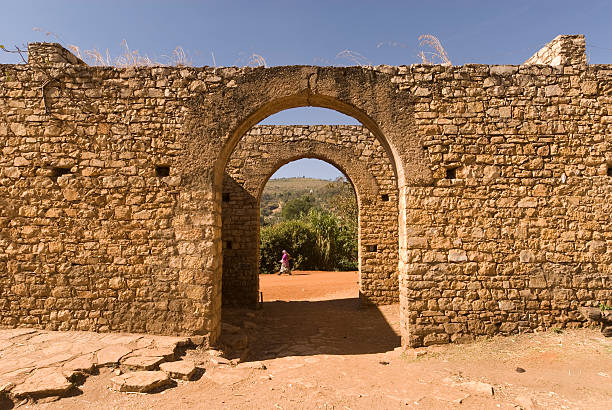
The city of Harrar is beautifully situated ,on a hillside at an elevation of 5500 feet above the sea level. It enjoys an excellent climate, and is the centre of a fertile province. The landscape is said to be of surpassing beauty. Coffee plantations flourish throughout the province. These are here and there interspersed with forests of valuable timber of pine, cedar, and juniper. Its mountains rise to 9000 feet above sea level. Its beauty and fertility have earned for it the name of "The Garden of Abyssinia" The city was built several centuries ago by the Arabs. The population to-, day is about 60,000, most of whom own allegiance'to the Moslem, faith. The better class of buildings, . such as mosques, churches, consular dwellings, and the homes of Arab traders who control the commerce of the city, are of stone. The poorer houses are of rubble..The city is encircled by an ancient stone wall with twenty-four towers. The entry and exit are through five gates. At the outbreak of the war the wall was breached by the authorities in several places, to give the people readier exit in case of attack. Harrar is connected by a good motor road with Diredawa, a town mid-way between Jibuti and Addis Ababa on the railway. It is 200 odd miles distant from the capital. RAS MAKONNEN'S CONQUEST. The city and province, though once part of the kingdom now known as Ethiopia, for many centuries was under Moslem rule, and acknowledged the suzerainty of Egypt. When in 1884 the Egyptian Government was weakened through the Mahdi's conquest of the Sudan, the garrison of Egyptian soldiers was withdrawn from Harrar. This diminished the power of the ruler, the Emir Abdillah. When .in 1337 Ras MakonnSn, father of Haile. Selassie, invaded the province with 8000 Ethiopian warriors,, the 'city fell an easy prey to Ethiopian arms. The
Emir was dethroned, and the province became part of the Ethiopian Empire.
Has Makonnen, who was nephew-of Menelik, then King of Shoa, was appointed Governor. He was described as a cultured," humane, and enlightened ruler.
It was in Harrar that his son Taffari, now the Emperor Haile Selassie, was born. He was educated at a French Roman Catholic Mission there, the buJdings of which are reported as having been destroyed by the recent aerial bombardment.
On the death of Has Makonnen his son Taffari succeeded to the Governorship of the province, and it still continues under the Emperor's control. Haile Selassie owns also vast coffee plantations in the district,
During the Great War Harrar became involved in a grandiose scheme of which Lij Nasa (Joseph) was the central figure. When Menelik II died in 1913, his nephew Lij Nasa, then a youth of seventeen, succeeded to the imperial throne. He is said even then to have been a dissolute craven. The Abouna was averse to crowning him Emperor, because of his evil habits, and also because of his flirtation with Islam. After the outbreak of the Great War emissaries were sent from Turkey and the Central Powers to stir up trouble in Ethiopia against the Allies; These gained the ear of Lij Nasa, and he became obsessed with the dream of a vast North-east African Moslem Empire to embrace Egypt, the Sudan, and all Somaliland, with headquarters in Abyssinia, and himself as Khalif, or supreme head. Lij abandoned the capital, Addis Ababa, for the more congenial company of . his Moslem subjects at Harrar. While at this centre he exchanged letters arid presents with Mohammed bin Abdulla Nassau (the Mad Mullah), who was leading a Jihad, or hoiy war, against British rule in Somaliland.
On account of his Moslem proclivities, the Abouna, at the instance of Ethiopian nobles, dethroned Lij Nasa in 1916. It fell to Has Taffari Makonnen, then in his early twenties, to lead the campaign against the dethroned Emperor. The Emperor's forces were hopelessly defeated and he was taken prisoner. Summary vengeance was taken against the Harrar Moslems who were involved in the conspiracy.
The aunt of Lij Nasa, Zauditu (Judith) was declared Empress, and Ras Taffari Makonnen, Regent.
! The Mullah hoped that the execution of the Harrar Moslems by Ras Taffari would Jead to a general rising of Moslems in Harrar, Ogaden, and throughout Somaliland against their "infidel" rulers. But Moslems in general felt that their slain co-religionists deserved their fate through being fooled by such a creature as Lij Nasa. In the present deplorable strife the Moslems of Harrar and throughout the Empire have shown no disposition to favour Mussolini against Haile Selassie, and, the wanton destruction of Harrar ' will deepen the mistrust of Italy, which is general throughout all Arab lands. 'I
-
When Arthur Rimbaud (1854-1891) abandoned poetry altogether in 1873, at the age of 19 or 20, he left behind a small, incendiary and revolutionary body of work that included "The Drunken Boat," A Season in Hell, and Illuminations, a series of mystical prose poems. He had come out of nowhere, from the small town of Charleville in the Ardennes. His parents were not literary. He began writing poetry at 13, serious poetry at 16. He came to Paris and befriended the poet Paul Verlaine. They had a tempestuous relationship which culminated in Verlaine's shooting Rimbaud in the wrist in a fit of hysteria. Verlaine went to prison; Rimbaud, after completing A Season in Hell, burned his papers and stopped writing altogether. All this in three short years.
From that point onward, Rimbaud led an itinerant life marked by an insatiable restlessness and, especially in the end, a concerted and frustrated quest for money. His wanderings took him from one unlikely place to another: from Indonesia, where he deserted from the Dutch colonial army; to Scandinavia, where he interpreted for a touring Danish circus; to Cyprus, where he supervised road-building gangs; and, finally, in 1880, to Aden in the British protectorate of Yemen near the southern entrance of the Red Sea. Intermittently, he returned—or was repatriated, sick or penniless, by the French diplomatic corps—to his family in Charleville. It was a life from which literature was completely absent. As far as I can determine, in all the letters he wrote to his family during these last years, he never once mentions literature. (He does mention books, but they are invariably technical or instructional ones.) He certainly never wrote poetry again. He did write, though: He published several pieces on East Africa, including a treatise on Ogaden that appeared in the bulletin of the French Geographical Society. It was decently, though not memorably, written, but its author hardly seemed the same Arthur Rimbaud who had upset and forever altered the French literary world.
In fact, like many before him and after, Rimbaud reinvented himself. The problem for posterity has been that with this reinvention, Rimbaud discarded his marvelous ability to spin words in the stars. When, some years later, Pierre Bardey's brother Alfred happened to learn that Rimbaud had written poetry and was revered in certain small circles in Paris, he confronted Rimbaud with this. Rimbaud seemed aghast: "Absurd! Ridiculous! Disgusting!" he said to Bardey. The Rimbaud who had written "The Drunken Boat" and A Season in Hell was dead and buried. The new Rimbaud wanted to make money. And, perhaps, to do some exploring and a bit of photography. This was the Arthur Rimbaud who arrived in Aden, Yemen in August of 1880: a different person entirely.
At that time, coffee had become extremely popular in Europe, and especially in France. Though the plant was being cultivated elsewhere— notably in Java by the Dutch—the best coffee was considered to come from Yemen. Coffee had come into its own there. The name of the port of al-Mukha in Yemen had become synonymous with coffee, and still denotes a certain superior quality today. For years, Arab merchants and traders had kept coffee entirely to themselves. Releasing it at last to the outside world, they then held a monopoly on its trade. They knew a good thing when they saw one.
Coffee's origin is placed variously in Yemen and Ethiopia, with most food historians now believing it to be the latter. Some believe that the word "coffee" derives from the name of the Ethiopian province of Kaffa. It was discovered perhaps as early as the ninth century, and the legend of its discovery was described by the French traveler Jean de La Roque in A Voyage to Arabia the Happy, published in English in 1726. La Roque writes that a goatherd noticed that after eating the berries of a particular bush his goats "leaped and frisked about all night." A local cleric heard of this and gave some of the berries to his disciples "to hinder them from sleeping, when they were called up to their prayers…."
It was not a great leap from munching the berries to making a decoction of them, and from that to roasting the "beans" they contained before
-
Opening of the permanent exhibition of the Sherif Harar City Museum On 24 December 2008, the Sherif Harar City Museum, located within the walled Jugol of Harar, Ethiopia, celebrated the opening of its permanent exhibition. The Sherif Harar City Museum’s collection was founded by the museum’s current curator, Mr. Abdulah Ali Sherif, who has painstakingly acquired regional cultural objects since the early 1990s. A significant part of the collection was donated to the museum by members of the Harari community who entrusted the care of their heritage objects to Mr. Sherif. Permanent exhibitions of the Sherif Harar City Museum include items from the following regional groups: Harari, Oromo, Amhara, Gurage, Somali and Argobba groups. The collection includes everyday items such as textiles, jewelry, coins, basketry and weaponry. A rich archive of historically significant manuscripts and music recordings are also on display. The Sherif Harar City Museum received financial and technical assistance from the UNESCO/Norwegian Funds in Trust Cooperation project "Preservation of the Collection for the Cultural Heritage of the Harar City Museum". This included support for the renovation of the Ras Tafari House (which hosts the museum), the making of an inventory of the collection, purchase of equipment, exhibition design and training of museum staff. Title Opening of the permanent exhibition of the Sherif Harar City Museum Short Description On 24 December 2008, the Sherif Harar City Museum, located within the walled Jugol of Harar, Ethiopia, celebrated the opening of its permanent exhibition. The Sherif Harar City Museum’s collection was founded by the museum’s current curator, Mr. Abdulah Ali Sherif, who has painstakingly acquired regional cultural objects since the early 1990s. A significant part of the collection was donated to the museum by members of the Harari community who entrusted the care of their heritage objects to Mr. Sherif. Permanent exhibitions of the Sherif Harar City Museum include items from the following regional groups: Harari, Oromo, Amhara, Gurage, Somali and Argobba groups. The collection includes everyday items such as textiles, jewelry, coins, basketry and weaponry. A rich archive of historically significant manuscripts and music recordings are also on display. The Sherif Harar City Museum received financial and technical assistance from the UNESCO/Norwegian Funds in Trust Cooperation project "Preservation of the Collection for the Cultural Heritage of the Harar City Museum". This included support for the renovation of the Ras Tafari House (which hosts the museum), the making of an inventory of the collection, purchase of equipment, exhibition design and training of museum staff. Source UNESCO Nairobi Publication start date 2009-01-20 9:05 am Publication expiry date 2009-01-20 9:05 am Author(s) of the present sheet Fumiko Ohinata Organizer UNESCO Nairobi Event Location Ras Tafari House City Harar Country Ethiopia Start date - Local time 2009-01-20 9:05 am End date - Local time 2009-01-20 9:05 am Type of event (generic) Exhibition Display related links & contacts in right column No Name of Contact 1 Fumiko Ohinata, UNESCO Nairobi E-mail address
-
In 1946 Makhtal established the SYC in Harar with himself as President. It is noteworthy that such an anti-British figure should head an important branch of what had been a very pro-British nationalist organisation. Indeed it seems Makhtal's initial presence in Harar was to complain against the British Military Administration and its continuing disarmament campaign in the Ogaden.38 Harar was an important spiritual and political centre for the Ogaadeen Somalis, and it was logical that the Somali political club should have a branch there. When Makhtal first arrived in Harar he was well received by the Ethiopian government, which saw him as an important historical ally in the Ogaden against British and Italian colonialism. Furthermore, in 1946 the SYC still appeared to an ally of Ethiopia, and the Ethiopian government saw that it could even be used to support claims for a greater Ethiopia, including not only the Ogaden but also ex-Italian Somaliland, or at the very least to prevent the restoration of the Italians to their former colonies. British sources report that while he was in Harar the Ethiopian government paid him a healthy monthly allowance.39
However, once in Harar Makhtal's politics began to change. Harar had been under full Ethiopian control since 1942 and like many areas of Muslim Ethiopia the local population did not wholly welcome restored Ethiopian government. Harari townsmen had been given a certain amount of privilege and promotion during the Italian occupation, resulting in a social and economic revival directly linked with the demotion of 'Amhara Christian' political dominance. But three years after the restoration of Harar to Ethiopia, Harari townsmen once again found themselves under the dominance of Ethiopian Christian outsiders, and had lost what social and economic gains they had made under the Italian regime. As a result of these grievances an ethnic Harari association was founded sometime in 1945 or 1946, which is remembered today with two Arabic titles, the jam'iya al-wataniya or jam'iya hurriya al harariya, translated respectively as 'the nationalist society' or 'the society for Harari freedom'.40 However when Makhtal Daahir established the SYC in Harar, the smaller Harari society allied itself and merged with the club, presumably to achieve more political influence. After exposure to the restored Ethiopian government in Harar and the local resentment it had engendered, Makhtal began to see the Ethiopian government as just as detrimental to Ogaadeen and Somali aspirations as he considered the British to be. British sources record that Makhtal's nationalism was further spurred by being kept waiting in Addis Ababa for an audience with the Emperor where he met several Eritrean Muslims who influenced his attitude to the restoration of Ethiopian rule.41
By early September 1947 Makhtal left Harar and returned to the safety of Ogaden, still under British Military Administration where the Ethiopian police had no jurisdiction. However, BMA jurisdiction did not deter the Ethiopian government from flexing its muscles in Jigjiga in the RA where Ethiopian police attempted to arrest the vice-President of the Harar branch of the SYL, Haji Kalile Ahmed, but where large numbers of SYL members prevented him being taken to Harar.45 In another symbolic act signalling the Ethiopian sovereignty of the Ogaden, the Ethiopian government granted a concession to the American Sinclair Oil Company to prospect for oil in the Ogaden still under the BMA.46 This was a clear sign that the Ethiopian government would now push for the return of the RA and Ogaden. Furthermore, in the face of an increasingly belligerent SYL and in anticipation of regaining control of the RA, the Ethiopians appointed a more vigorous Ethiopian representative in Jigjiga whom the British officials described as 'a senior official of strong anti-British persuasion to check the growth of the SYL in Jigjiga'.47 The Ethiopian government, not without foundation, strongly suspected that the British were fostering the growth of the SYL.48
-
Harar, the second largest city in Abyssinia, was practically destroyed to-day, when 37 Italian bombers engaged in a mass air raid on the city.
-
Religious difference in Islam: case studies from Harar
Harar is a town in the eastern region of Ethiopia. It is located near
the border of what is now Somaliland and has approximately 100,000
inhabitants who belong to different ethnic groups, mainly Hararis,
Oromo, Amhara and Somalis. In this section I concentrate mainly on
the Harari people who are the descendents of local groups and Arab
immigrants and thus claim to be the founders of the city. Despite being
a minority—they represent only seven percent of the town’s population—
they enjoy an elevated status among their ethnic neighbours based
on their economic power as traders and their religious knowledge. Since
the reorganization of administrative structures by the state since 1991,
Harar has become the smallest administrative unit in Ethiopia. This
development guarantees special legal rights for the Hararis and underlines
the importance of their current political role. Despite the fact that
Harar has relinquished its status as the most influential Islamic centre
in the Horn of Africa, it has retained its symbolic capital. This is
reflected in local terms such as madìnat al-awliyàh, the city of saints, and
its label as the fourth holiest city in Islam. While the latter undoubtedly
involves the reinvention of a weak local tradition by today’s tourism
sector, the former term is actually legitimate as the town contains hundreds
of saintly places inside its old walls and many Islamic shrines
in the countryside beyond. Historically, the town attracted many religious
scholars and students and thus became a centre of religious learning.
It was also an important trade centre linking the Red Sea with
the interior of Ethiopia, and this role lends it its special importance.
Harar was established in the thirteenth century and later emerged as
the capital of the Sultanate of Adal. In the sixteenth century, Imàm
A˙med Ibràhìm, a Muslim scholar from the region of Harar, nicknamed
‘Grañ’, the left-handed, succeeded in uniting different quarrelling
488 Patrick Desplat
The Articulation of Religious Identities and their Boundaries in Ethiopia 489 factions of Muslims and conquered extensive parts of Ethiopia during
a djihàd (1529-1543) against the Christians. With the defeat of Imam
A˙med (1543) and the later migration of the Oromo, Harar became
a city-state governed by an emirate. It was captured in 1875 by Egypt
and in 1887 the then emperor Menelik II incorporated Harar into
the wider empire of Ethiopia, imposing a Christian rule for the first
time.
-
The Extended East Route An International Symposium on the new cultural, naturalistic tourism route in the Ethiopian East concludedWe Have started work on a new Tourism Route. The long expected alternative to the Great Ethiopian North, designed in.. 1966. A concrete possibility of income for many thousands, of fresh needed foreign earnings for Our Land.This section covers over 40 pages, list of contents:- Harar Symposium programme- Ten points to realize the new Route- What is the Extended East Route?- First notes on the Somaliland leg of the Route- Birdwatching, preliminary scientific enquiries, partecipation to a significant ornitological congress. Proposal to realize a Bird Guide to the Ethiopian East.- Why the Kundudo is a focal point of the East Tourism Route- The two most recent discoveries on the Kundudo range- Notes on the first steps undertaken, about a visit to the Oromia State President- A visit to the Kundudo, in... 1853The Harar SymposiumWhat we did: September 25, early morning. Departure from Addis Ababa. Lunch in Nazaret, brief visits along the way, like at the Giulietti pass Caldera, lake Beseka, along the Amhar mountain chain. Night in Harar. Guests of the local Cultural and Tourism Office, for some experts, at the Home of Dr. Nasib, an Harari personality.
-
A fantastic Karst cave field THIS SITE SECTION CONTAINS TEN NOTES ON EXPLORATIONS I RECENTLY LED. If you reached us via a search engine, please scroll to the section of your interest.About a year ago, after the rediscovery of a feral horse pack on the flat top of Mount Kundudo, I tried understanding its geology by visiting its lower parts too. The top is a stunning humid area, with grasses and a few remnant shrubs, it hosts a variety of wildlife including many couples of Lammergeier, the rare bird of prey, mustelids and baboons. Rocks up there are all very acidic, splitting black basalts, that form a cave just under the top. From the cave flows the Immis stream, that immediately forms a spectacular 250m waterfalls with four jumps. Just under, the rocks turn suddendly from black to white. It is clear the 400m of basalts had protected the underlying mass of limes, letting the Kundudo stand prominently at nearly 3000m, dominating the whole area and giving us views over Harar and as far as Hargeisa in Somalia. Springs and streams flow from all around its base, giving the Gursum province a fame for the production of all sort of horticultural goods, lately, of chat for export
-
Moving eastward to consider Eritrea, Ethiopia and Somalia, our
information is very patchy and uneven. However, one contrast with other areas of
Muslim Africa is that northeastern Africa has received the attention of a number
of distinguished Orientalists. Thus Enrico Cerulli has written with great authority
on the Arabic writings of Somalia while Ewald Wagner has comprehensively
catalogued, described and analysed the indigenous writings, in Arabic, Harari,
and Silte, of the city state of Harar.9 More recently researchers such as Hussein
Ahmed (Addis Ababa), Scott Reese (Northern Arizona University ), Alessandro
Gori (Naples) and Jonathan Miran (Michigan State University) have been
8 ˘asan b. Mu˛ammad al-Fti˛ b. Qarıb Allåh; see ALA I, 113.
9 See Afrikanischen Handschriften, II, Islamiche Handscriften aus Äthiopien, Stuttgart, 1997.
14
actively engaged in mapping and cataloguing in the region. What is known to
date of the Islamic writings of northeastern Africa is brought together in ALA
IIIA, entitled The Writings of the Muslim Peoples of Northeastern Africa,
published by Brill, early in 2003.
-
The DSA Project is providing technical assistance to the Government of
Ethiopia’s Civil Service Reform in the areas of budget, accounts and
expenditure planning. The DSA Project is implemented by Harvard
University and funded by USAID, Ireland Aid and the Netherlands
Ministry for Development Corporation.
Project at the Federal Government and in the Tigray, SNNP, Oromia,
Amhara and Beneshangul/Gumuz regions. The Accounts Reform has so
far been implemented with the support of the DSA Project at the Federal
Government and in the Tigray, SNNP and Amhara regions.
The DSA Project was extended from July 1 2004 to November 30,2006 to
ensure that the above reforms are extended to all regions and
administrative areas of Ethiopia. A part of the work plan agreed with the
Ministry of Finance and Economic Development envisages that the budget
and the accounts reforms are introduced in Hararri Region in FY 1998-99.
To achieve this goal, the reform activities should commence in FY 1997-98.
The DSA Project conducted an assessment of the Region in September
2004 with the following objectives:
• To obtain a full understanding of the Region in areas such as
restructuring, status of the budget reform, status of accounts closure,
and its impact on the Budget and Accounts Reform.
• To identify whether adequate technical staff capacity exists to
effectively implement the reforms.
• To identify other constraints that may negatively impact the
introduction of Accounts Reform in the Region.
• To develop a joint action plan and strategy to strengthen the Budget
Reform and implement the Accounts Reform.