-
Traditional Harari basketry within the Harari ethnic group. However, between the mid-1970s and the mid-1990s, a sharp decline in weaving among the younger generation of women became apparent to outside researchers, NGOs and the Harari alike. Moreover, the production of several seems to have been significantly reduced in those waning years of craft production.By the late 1990s, there was an attempt to preserve the material culture of the Harari people,and also provide a forum for groups of Harari women to gain greater economic self-reliance through craft work. The three women's weavers associations that were established within the old walled city of Harar at that time are still functioning. These fairly recently formed Harari women's craft guilds have yet to be effectively documented, yet their contributions to the preservation of the Harari way of life may be profound.After an introduction this paper will highlight some organizational differences, challenges, and successes of the three Harari women weaver’s guilds.
-
Baskets and woven mats are the oldest and most diverse plant-based crafts found around the world. The skill required in the production of these objects is often associated with factors such as people's perceptions of the environment, conceptions of the self and modes of economic interaction, social hierarchy, and division of labour. Basketry knowledge has also significant ecological ramifications,as it includes specific strategies for the sustainable management of plant resources. Moreover,the study of plaited crafts can be linked together with important themes such as the studies of plant distribution, the trade routes of human groups and the discovery, diffusion and transmission of new technologies and techniques.
-
These web pages were prepared by Dr Simone Tarsitani during a Leverhulme Trust Visiting Fellowship (November 2008 & September 2009) at the Music Department of the Open University, drawing on over ten years of research on the Islamic rituals performed in Harar, Ethiopia. The main purpose of the work has been to develop a comprehensive analysis of the performance of the rituals, based on the large body of audiovisual documentation collected during previous fieldwork. Zikri is the Harari word for the Arabic “dhikr” and refers to an exercise (typical of Sufism), which consists of the repetition of the name of God in order to receive his blessing. The rituals performed in the city of Harar, important centre of Islamic learning in Ethiopia, are derived from the influence of Sufi orders, widespread in the Islamized areas of the Horn of Africa. However, the cult of saints in Harar developed particular beliefs and rules that go beyond the discipline of Sufi orders and zikri rituals can be considered an original expression and one of the unique elements of the culture of this town. The wide repertoire of texts written in the local language, the sung melodies and their rhythmic accompaniment, the ritual and social function of their performance developed distinctive characteristics. Historically and contemporaneously, zikri rituals have permeated Harari life and the repertoire of songs has expanded beyond its origin of liturgical hymns, to become one of the facets of Harari identity.
-
College of Education, Addis Ababa UniversityABSTRACTThe purpose of this article is to show that cassette and CD recordings of Harari pop songs are significant and useful in promoting public policies in the education and culture sectors. The method employed for this study is both quantitative and qualitative analysis. The study is based on Harari songs released on seventeen cassettes or CDs, and is supplemented by an investigation of objectives set forth in Ethiopia’s Culture Policy, and Education and Training Policy. Purposive sampling was considered and categories were delineated for the songs as well as the objectives of the policies. Then the core messages of the songs were compared with the objectives of the policies. The education and Training Policy while eleven songs reflected the Cultural Policy. The core message of these and similar songs may best be evaluated in terms of the overt and subtle contributions of musical expressions in preserving local knowledge; they can be useful in promoting education, protecting cultural heritage, and maintaining societal norms and values.
-
In my paper I would like to try to describe in a philological and comparative perspective the content of the constellation of texts most commonly known under the title of number of manuscripts kept in Harar, in Ethiopia and abroad and in at least four different printed editions. It contains the basic textual material recited and sung in Harar during Mawlid sharaf al-‘alamin.” The collection is preserved and transmitted in a quite relevantMawlūd feasts and other collection will be dealt with. The complex and variegated nature of the in different suggestions that were at work in the process of formation and development of the tradition and the musical and liturgical functions of the texts of the collection will be analyzed.
-
-
Health To assess the prevalence of cigarette use and its determinant factors among high school students in eastern Ethiopia. A cross-sectional study was conducted using structured self-administered questionnaires among 1,721 school adolescents in Harar town, eastern Ethiopia. Univariate and multivariate logistic regression analyses were performed to examine associations.
-
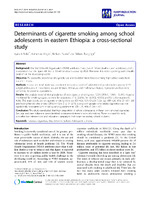
HealthTo assess the prevalence of cigarette use and its determinant factors among high school students ineastern Ethiopia.A cross-sectional study was conducted using structured self-administered questionnaires among 1,721 school adolescents in Harar town, eastern Ethiopia. Univariate and multivariate logistic regression analyses were performed to examine associations.
-
INTEGRATING LOCAL KNOWLEDGE IN ETHIOPIANARCHIVES:MUSIC AND MANUSCRIPTS IN THE COLLECTIONOF ABDULAHI ALI SHERIFBelle Asante TARSITANIGraduate School of Asian and African Area Studies, Kyoto UniversitySimone TARSITANIDepartment of Music, The Open University, UKABSTRACTSince the early 1990s, important examples of Harari tangible and oral cultural heritage were preserved in the private home museum of Abdulahi Ali Sherif in Harar, Ethiopia.The volume and quality of audio recordings of musical and ritual practices, along with the manuscripts from this collection indicate how a resourceful individual, when supported by a community of local patrons, can be instrumental in conserving heritage in a local archive, even in the absence of major funding sources. This case study presents a review of Mr. Sherif’s museum collection and explores pertinent challenges in conservation and curatorship of the private holdings. Having followed the transformation of the collection to a public-private partnership,the authors consider the wider implications of collaborations in the management of archives in regional museums in Ethiopia. This research employs examples of various forms of documentation used in the analysis of local Islamic ritual practices to show that local actors are integral to the sustainable management of archives. The collaborations involving the collectionof music and manuscripts in the Sherif collection are presented as exemplary of how a community-run museum project can be a particularly appropriate and accessible venue to engage audiences in the legacies found in archives
-
Department of History and Heritage Management, Addis Ababa UniversityABSTRACTSince at least the sixteenth century, the areas of the present day regions of Harar and Wallo have been important centres of teaching and diffusion of Islam as well as of preservation of Islamic culture and education. Preachers and scholars from these areas played a decisive role in the introduction and dissemination of the faith in the country, especially in the eighteenth and nineteenth centuries. They contributed to the further development and consolidation of both Islamic institutions and law, and mysticism as manifested in the propagation of the religious orders, veneration of saints, and visits to shines. They also actively promoted and sustained a tradition of Islamic reform and renewal. Overcoming their geographical distance,the two regions maintained close contacts through the Islamic school system, movement of teachers, students and instructional materials, and exchange of goods and services.
-
Auhor discusses Harar Traditional Song and the Harai Women's Contribution
-
SECTION 1: BACKGROUND AND PURPOSE1.1 INTRODUCTIONThe DSA Project is providing technical assistance to the Government of Ethiopia's Civil Service Reform in the areas of budget, accounts andexpenditure planning. The DSA Project is implemented by Harvard University and funded by USAID, Ireland Aid and the Netherlands Ministry for Development Corporation. The Budget Reform has so far been implemented with the support of theDSA Project at the Federal Government and in the Tigray, SNNP, Oromia,Amhara and Beneshangul/Gumuz regions. The Account Reform has sofar been implemented with the support of the DSA Project at the Federal Government and in the Tigray, SNNP and Amhara regions.The DSA Project was extended from July 1 2004 to November 30,2006 to ensure that the above reforms are extended to all regions and administrative areas of Ethiopia. A part of the work plan agreed with the Ministry of Finance and Economic Development envisages that the budget and the accounts reforms are introduced in Hararri Region in FY 1998-99.